Role
UI/UX Designer
Role
UI/UX Designer
Role
UI/UX Designer
Role
UI/UX Designer
Timeline
October 2025
Timeline
October 2025
Timeline
October 2025
Timeline
October 2025
Tools
Sketch
Tools
Sketch
Tools
Sketch
Tools
Sketch
Designing Controlled API Access
Designing Controlled API Access
Designing Controlled API Access
Designing Controlled API Access
Creating a structured request and approval process for contract-based API access.
Creating a structured request and approval process for contract-based API access.
Creating a structured request and approval process for contract-based API access.
Creating a structured request and approval process for contract-based API access.

BACKGROUND
BACKGROUND
Open API is an internal portal that allows clients to request access to specific APIs from our TV management platform without using the full portal.
Open API is an internal portal that allows clients to request access to specific APIs from our TV management platform without using the full portal.
Open API is an internal portal that allows clients to request access to specific APIs from our TV management platform without using the full portal.
Because API access is governed by contractual agreements, clients can only request APIs they are entitled to use. Each request must go through an approval process before access can be granted.
Because API access is governed by contractual agreements, clients can only request APIs they are entitled to use. Each request must go through an approval process before access can be granted.
Because API access is governed by contractual agreements, clients can only request APIs they are entitled to use. Each request must go through an approval process before access can be granted.
My role was to design the end-to-end request experience, including API selection, approval path configuration, request tracking, and supporting communications throughout the approval journey.
My role was to design the end-to-end request experience, including API selection, approval path configuration, request tracking, and supporting communications throughout the approval journey.
My role was to design the end-to-end request experience, including API selection, approval path configuration, request tracking, and supporting communications throughout the approval journey.
CHALLANGES
CHALLANGES
Designing Open API required balancing ease of use with governance and access control.
Designing Open API required balancing ease of use with governance and access control.
Designing Open API required balancing ease of use with governance and access control.
1
Making API request submission straightforward despite approval requirements.
1
Making API request submission straightforward despite approval requirements.
1
Making API request submission straightforward despite approval requirements.
2
Helping users configure approval paths without unnecessary effort.
2
Helping users configure approval paths without unnecessary effort.
2
Helping users configure approval paths without unnecessary effort.
3
Providing clear visibility into request progress throughout the approval process.
3
Providing clear visibility into request progress throughout the approval process.
3
Providing clear visibility into request progress throughout the approval process.
3
Providing clear visibility into request progress throughout the approval process.
Another constraint was that direct usability testing with end users was not available during development. Design decisions were shaped through discussions with the Product Manager and iterative reviews within the UI/UX team.
Another constraint was that direct usability testing with end users was not available during development. Design decisions were shaped through discussions with the Product Manager and iterative reviews within the UI/UX team.
Another constraint was that direct usability testing with end users was not available during development. Design decisions were shaped through discussions with the Product Manager and iterative reviews within the UI/UX team.
LIMITATIONS
LIMITATIONS
The design needed to work within several business and technical constraints.
The design needed to work within several business and technical constraints.
The design needed to work within several business and technical constraints.

API access must follow contractual agreements between clients and internal teams.
API access must follow contractual agreements between clients and internal teams.
API access must follow contractual agreements between clients and internal teams.

Multiple stakeholders may be involved in a single approval chain.
Multiple stakeholders may be involved in a single approval chain.
Multiple stakeholders may be involved in a single approval chain.

Approval requirements and permission rules are governed by existing business processes.
Approval requirements and permission rules are governed by existing business processes.
Approval requirements and permission rules are governed by existing business processes.

Limited access to end users during development restricted direct usability testing.
Limited access to end users during development restricted direct usability testing.
Limited access to end users during development restricted direct usability testing.
KEY DECISIONS
KEY DECISIONS
To address these challenges, I focused on reducing unnecessary complexity while maintaining required approval controls.
To address these challenges, I focused on reducing unnecessary complexity while maintaining required approval controls.
To address these challenges, I focused on reducing unnecessary complexity while maintaining required approval controls.
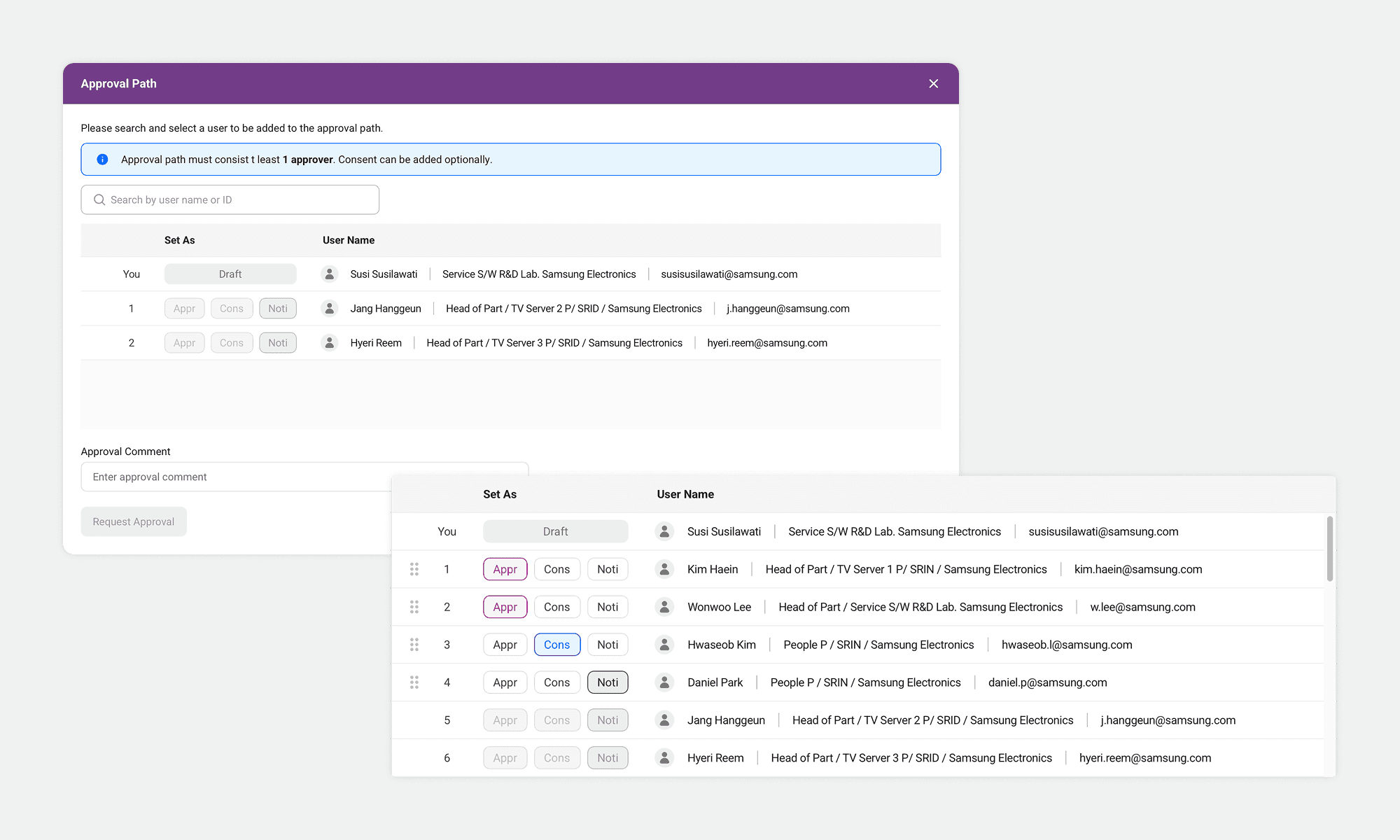
Approval Path Configuration Modal
Introduced predefined approval paths
Configuring approvers manually for every request could become repetitive and error-prone. To streamline the process, I proposed predefined approval paths that were automatically populated when users submitted an API request. Users could still add additional approvers or notifiers when needed, while mandatory approvers remained fixed. This reduced setup effort while maintaining required approval controls.
Approval Path Configuration Modal
Introduced predefined approval paths
Configuring approvers manually for every request could become repetitive and error-prone. To streamline the process, I proposed predefined approval paths that were automatically populated when users submitted an API request. Users could still add additional approvers or notifiers when needed, while mandatory approvers remained fixed. This reduced setup effort while maintaining required approval controls.
Approval Path Configuration Modal
Introduced predefined approval paths
Configuring approvers manually for every request could become repetitive and error-prone. To streamline the process, I proposed predefined approval paths that were automatically populated when users submitted an API request. Users could still add additional approvers or notifiers when needed, while mandatory approvers remained fixed. This reduced setup effort while maintaining required approval controls.
Approval Path Configuration Modal
Introduced predefined approval paths
Configuring approvers manually for every request could become repetitive and error-prone. To streamline the process, I proposed predefined approval paths that were automatically populated when users submitted an API request. Users could still add additional approvers or notifiers when needed, while mandatory approvers remained fixed. This reduced setup effort while maintaining required approval controls.

Approval Path Mandatory Flow
Made approval path configuration a required step before submission
Every API request required a valid approval chain before it could proceed. Rather than allowing requests to be submitted first and configured later, approval path configuration became a required step within the request flow. This ensured requests were routed correctly from the start and reduced the risk of incomplete submissions.
Approval Path Mandatory Flow
Made approval path configuration a required step before submission
Every API request required a valid approval chain before it could proceed. Rather than allowing requests to be submitted first and configured later, approval path configuration became a required step within the request flow. This ensured requests were routed correctly from the start and reduced the risk of incomplete submissions.
Approval Path Mandatory Flow
Made approval path configuration a required step before submission
Every API request required a valid approval chain before it could proceed. Rather than allowing requests to be submitted first and configured later, approval path configuration became a required step within the request flow. This ensured requests were routed correctly from the start and reduced the risk of incomplete submissions.
Approval Path Mandatory Flow
Made approval path configuration a required step before submission
Every API request required a valid approval chain before it could proceed. Rather than allowing requests to be submitted first and configured later, approval path configuration became a required step within the request flow. This ensured requests were routed correctly from the start and reduced the risk of incomplete submissions.

Status Visibility
Designed a clear status flow to improve visibility
API requests often involve multiple approval steps and stakeholders. To help users understand where their request stands, I introduced clear request statuses such as Request Approval, API Key Issued, Canceled, Rejected, and Invalid. Visibility was extended beyond the portal through email notifications, informing users when requests were approved or when API keys were refreshed.
Status Visibility
Designed a clear status flow to improve visibility
API requests often involve multiple approval steps and stakeholders. To help users understand where their request stands, I introduced clear request statuses such as Request Approval, API Key Issued, Canceled, Rejected, and Invalid. Visibility was extended beyond the portal through email notifications, informing users when requests were approved or when API keys were refreshed.
Status Visibility
Designed a clear status flow to improve visibility
API requests often involve multiple approval steps and stakeholders. To help users understand where their request stands, I introduced clear request statuses such as Request Approval, API Key Issued, Canceled, Rejected, and Invalid. Visibility was extended beyond the portal through email notifications, informing users when requests were approved or when API keys were refreshed.